Primary buyer interest
Cellular energy and metabolism
MOTS-c is studied in AMPK, stress adaptation, glucose handling, and mitochondrial signaling.
 COA Verified
Mitochondrial Peptides
$80.00
Purchase option
Strength
Buy more, save more
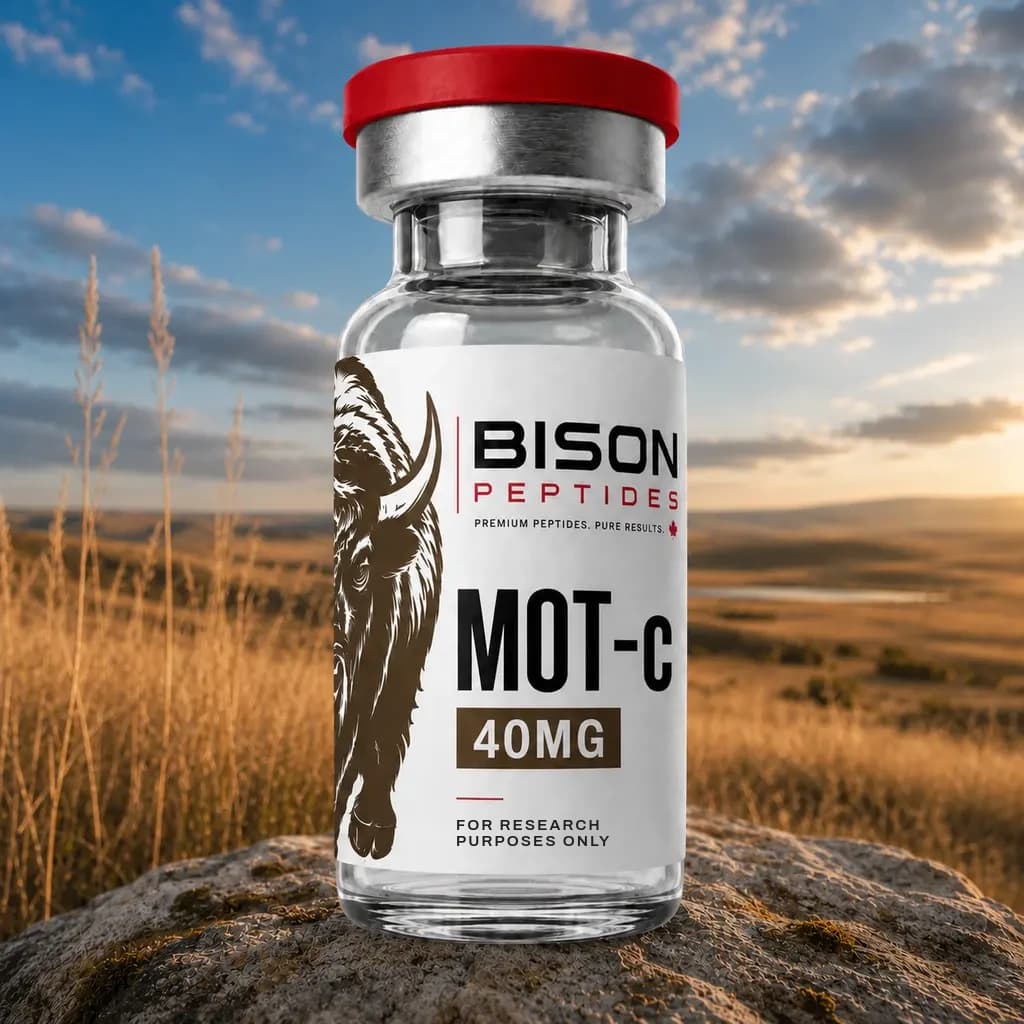
MOTS-c is a mitochondria-derived peptide encoded by a short open reading frame within the mitochondrial 12S rRNA region. The Bison catalog lists the product as MOT-c and supplies a 40mg lyophilized research vial.
Published research examines mitochondrial-to-nuclear signaling, cellular stress adaptation, energy metabolism, and AMPK-related pathways. This material is not intended for human or veterinary administration.
Orders ship from within Canada in discreet packaging. Express delivery is typically 1–3 business days after dispatch.
Standard returns are not accepted because research materials cannot be safely restocked after delivery. Contact support promptly about damaged, incorrect, or compromised items.
Reconstitution calculator
Enter three known values. The calculator converts the total vial amount and water added into a concentration, then shows the liquid volume and equivalent U-100 syringe units for the quantity entered.
The calculator does not choose a quantity. It converts the quantity you enter. One milligram equals 1,000 micrograms.
Bacteriostatic water is generally the most appropriate choice for multi-use research preparation because it contains a preservative for repeated vial access.
MOTS-c buyer and evidence guide
MOTS-c is usually compared by buyers interested in energy, exercise capacity, glucose metabolism, mitochondrial signaling, and healthy aging. It is a naturally occurring mitochondria-derived peptide that helps cells communicate metabolic stress to the nucleus and is closely associated with AMPK signaling.
The science is interesting but easy to overstate. Human studies show that the body's own MOTS-c changes with exercise and metabolic state, while the widely shared performance and longevity results mostly come from mice given synthetic MOTS-c. There is not yet robust evidence that an exogenous 40mg vial produces those outcomes in people.
Primary buyer interest
MOTS-c is studied in AMPK, stress adaptation, glucose handling, and mitochondrial signaling.
Exercise link
Small human studies measured changes in the body's own MOTS-c around exercise.
Evidence reality
Human treatment trials have not established improved endurance, fat loss, or longevity.
Product decision
The main purchase is standalone MOTS-c, with identity spelling and COA alignment worth checking.
Evidence for mechanism and animal performance is much stronger than evidence for exogenous use in humans.
| Evidence | What was studied | What was reported | Buyer takeaway |
|---|---|---|---|
| Foundational cell and mouse research | Metabolic stress, glucose handling, and AMPK pathways | Improved selected metabolic outcomes in experimental models | Strong mechanistic interest, not human proof |
| Exercise and aging mouse research | Young, middle-aged, and old mice | Improved physical capacity and selected healthspan measures | Performance and longevity claims remain preclinical |
| Human observational studies | Endogenous MOTS-c around exercise or metabolic conditions | Circulating or muscle MOTS-c changed in some settings | Does not establish benefit from synthetic MOTS-c |
No robust controlled human trial has established that a synthetic MOTS-c product improves energy, endurance, fat loss, insulin sensitivity, or lifespan.
MOTS-c stands for mitochondrial open reading frame of the 12S rRNA type-c. Unlike most peptides, it is encoded within mitochondrial DNA. Under metabolic stress, it can influence nuclear gene expression, cellular fuel use, and stress-adaptation pathways.
That biology makes it attractive to people researching fatigue, exercise, insulin sensitivity, metabolic health, or aging. The realistic evidence-led interpretation is that MOTS-c is a promising signal molecule, not a clinically proven energy booster, weight-loss treatment, or longevity intervention.
Foundational cell and mouse work linked synthetic MOTS-c with AICAR accumulation, AMPK activation, improved glucose handling, and resistance to diet-induced metabolic stress. Later mouse studies reported improved physical capacity and selected healthspan measures, including in older animals.
The human part of that research is narrower. Small studies found that exercise can change endogenous MOTS-c in muscle or circulation and that circulating levels differ across metabolic populations. Observing the body's own peptide is not the same as proving that externally supplied MOTS-c improves performance or disease outcomes.
The compounds answer different buyer questions and have very different evidence maturity.
| Product type | Primary interest | Human outcome evidence | Best fit |
|---|---|---|---|
| MOTS-c | Mitochondrial stress and energy signaling | Early and mostly observational | Mechanistic energy and exercise research |
| Semaglutide or Tirzepatide | Appetite, glucose, and body weight | Large randomized trials and authorized formulations | Evidence-led weight-management comparison |
| Retatrutide | Triple incretin and glucagon signaling | Phase 2 publications and Phase 3 development | Investigational weight and metabolic research |
MOTS-c should not be marketed as another GLP-1-style weight-loss product. Its main value is the distinct mitochondrial signaling question.
MOTS-c is the more direct catalog choice when the research question is mitochondrial stress signaling, exercise adaptation, or cellular energy rather than appetite suppression. It is mechanistically different from Semaglutide, Tirzepatide, and Retatrutide and should not be compared as if it were another established weight-loss agonist.
A buyer whose main goal is evidence-backed weight reduction will find much stronger human outcomes on the GLP-1 and incretin pages. MOTS-c is better suited to someone who specifically values early-stage mitochondrial biology and accepts the large gap between mouse performance results and human treatment evidence.
The 40mg label states total nominal lyophilized material in the vial. The catalog uses MOT-c while scientific papers use MOTS-c, so buyers should confirm that the vial and COA identify the intended sequence rather than relying on the shortened product name.
Bison currently lists one size, so the decision is mainly whether early-stage MOTS-c biology matches your goal. Choose this product for a specific mitochondrial-peptide research interest, not as a substitute for compounds with established human weight-loss outcomes.
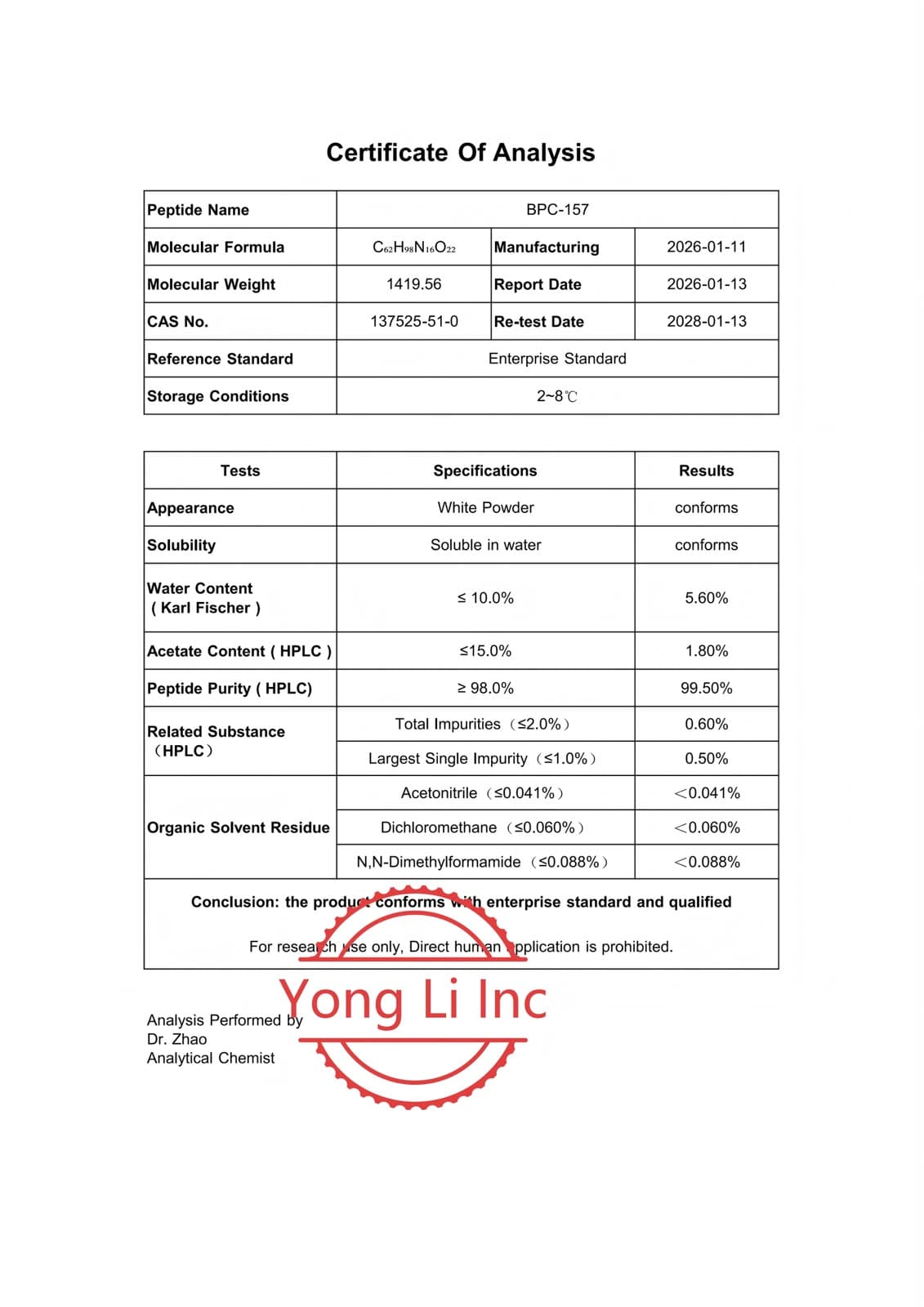
The listing identifies independent testing and COA availability. Before ordering, confirm that the available certificate identifies the compound or blend, batch or lot, test date, analytical method, and reported result. After delivery, compare the vial label with that exact documentation rather than relying on a generic certificate.
Identity, purity, fill quantity, sterility, and endotoxin testing answer different questions. A large purity percentage does not prove every other quality attribute, so buyers should check which tests are actually reported and avoid assuming that an unlisted result was performed.
The Bison Peptides MOTS-c vial is supplied as a technical laboratory research material, not an authorized prescription formulation. The page summarizes published research to help buyers understand the compound, evidence, and product format; it is not an individual treatment or dosing recommendation.
Content reviewed August 11, 2026 by the Bison Peptides editorial team.
“I had trouble finding a Canadian supplier carrying MOTS-c in the strength I wanted, so I was happy to see the 40mg option here. Ordering was easy and everything arrived safely. The vial and packaging both looked professional and matched what was shown online.”
40mg ·
Nathan B. · Verified buyer
“No issues at all with my MOTS-c order. The website was easy to use, payment went through without any hassle, and the package arrived in good condition. The 40mg vial was securely protected and clearly labeled. Exactly the type of experience I want when ordering online.”
40mg ·
Dylan C. · Verified buyer
“I was mainly looking for a Canadian source so I wouldn't have to deal with an international order. Everything arrived as described and the vial was packaged securely. Shipping could have been a little quicker, but other than that the experience was very good.”
40mg ·
Jeremy F. · Verified buyer
MOTS-c is studied for mitochondrial-to-nuclear signaling, AMPK, glucose metabolism, cellular stress adaptation, exercise capacity, and age-related physical decline. Most intervention findings come from cells and animals.
That has not been established in robust controlled human trials. Mouse studies reported improved physical capacity, while human studies mainly measured changes in the body's own MOTS-c around exercise.
It has metabolic and obesity-related animal research, but it does not have the large human weight-loss trials available for Semaglutide or Tirzepatide. Buyers should not expect equivalent evidence or predictable scale-weight outcomes.
It means the vial lists 40mg of total lyophilized material. It does not describe a prepared concentration, a recommended amount, or how long the vial will last.
MOTS-c is the scientific name used in published literature. The Bison catalog shortens it to MOT-c. Buyers should confirm the intended MOTS-c identity and sequence on the current label and COA.
MOTS-c is a mitochondria-derived signaling peptide with mostly preclinical outcome evidence. Retatrutide is an investigational GIP, GLP-1, and glucagon agonist with randomized human weight-loss trials. They address different questions.
Look for the MOTS-c identity or sequence, batch or lot, test date, analytical method, and reported purity or identity result. A purity percentage alone does not prove fill accuracy, sterility, or endotoxin control.